Showing posts with label meeting recap. Show all posts

Wednesday, April 19, 2023

Tomorrow, and Tomorrow, and Tomorrow: A novel


NEW YORK TIMES BEST SELLER • Sam and Sadie—two college friends, often in love, but never lovers—become creative partners in a dazzling and intricately imagined world of video game design, where success brings them fame, joy, tragedy, duplicity, and, ultimately, a kind of immortality. It is a love story, but not one you have read before.


Tomorrow and Tomorrow and Tomorrow follows Sam and Sadie through their childhood meeting, college reunification and the development and success of their business.   

Gabrielle Zevin does a masterful job of maturing the voices of each character over the years and the technical aspects of describing the games they created was detailed and fun to follow.   

As a kid of the 80's the evolution of online games from the Oregon Trail to the role playing games of today is a journey worthy of understanding.  It is a great metaphor for the changes we go through as we become fully formed people.  How the experiences in our lives make for a richer, more colorful experience.

Zevin uses the two characters to narrate from their own perspective, but it isn't repetitive and each has a unique view and of course different priorities and drivers.  

As a story of a lifelong friendship, the cadence also rings true.  Sometimes the friends are in lock step, lives intertwined and at others they are separated but still care deeply for another.  

I appreciated that the characters loved one another, but didn't have to have a grand romantic arc. 

Read:  April 19, 2023
Met: @ Beth's
Book Choice: Melinda

Thursday, January 20, 2022

Book of the year 2021 and other things...

 Our end of year wrap up ended up returning to the zoom format because a few of us had close calls with exposures.  In spite of not being together in person, this was a fun, joyous and energetic gathering. 

Mid-meeting wine run

We started the gathering with a great discussion of our final book for 2021, Calm Sea and Prosperous Voyage by Bette Howland.   A book of short stories can be hard to discuss because of the lack of a through plot and common characters, but not this one.  Ms. Howland created rich details that brought you into the space where her characters were.  Dark and not uplifting was one comment but others found interest in the planning of a funeral, the frustration of obligatory time with family and other 'every day' life events.  Certainly a worthwhile read. 

We turned our attention to the discussion of our favorite and least favorite (never "worst") book of the year.  I am still living in constant fear that the author of a "worst" book will again google themselves to find that our group of seven readers has mortally wounded their pride and that we may be invited to a duel.  I don't like conflict and as I only dabble in sarcasm I am afraid of those who have mastered the art of prose.  Therefore we will refrain evermore from the use of the word worst to describe our least favorite book of the year.

HOWEVER, with a solid majority and very little surprise or argument from the minority the clear winner of our least favorite was "50 words for rain".   This book should have been a beautiful novel of love, loss, grace, forgiveness, finding one's purpose under the epic backdrop of post WWII for the ages, but it was not.  Imagine the fan fiction journal of a millennial 15 year old who has never been kissed or left their hometown of Springfield, wherever writing about the complexities of racism in a country, culture and era never explored beyond watching an anime movie or two.  Then throw in some plot twists like sexual assault that is almost instantly forgiven without any trauma, grief, blame and heck, let's just make the main character fall in love with that guy because he is of course, beautiful, rich and charming.  👀.  Of course he is.  Anywho...this was a literal car crash that needed an editor.  Acknowledging that storytelling is hard, we are hopeful that as the author matures better content will come.  

The discussion for the favorite book of the year was far more varied.  The field of books that we loved was many in 2021.  With the bonus reading titles off the table for consideration, the much appreciated "A Children's Bible" and "The Cold Millions" made room for the primary books.

Hidden Valley Road, No No Boy, Hamnet and Calm Seas and Prosperous Voyage all received ardent votes for favorite.  

Damnation Springs and Unbound each were noted as "very good".  

It's a good problem to have that we loved most of what we read in 2021.  We decided to let our 'favorite' be a three-way-tie:

Hidden Valley Road, Inside the Mind of an American Family by Robert Kolker

 No-No Boy John Okada

Hamnet by Maggie O'Farrell

Each was completely different and wonderful.   HVR, is an exploration of mental illness in one family and a frustrating study in the pharmaceutical industry exploring that it is profits that drive innovation and not need. 

No-No Boy explored the often ignored history of the American Japanese experience of  the aftermath of the war and those who would not or could not join in to fight with the US in the land of their ancestors. 

Hamnet is a fanciful dip into the household of William Shakespeare and the family he left behind to be a poet and play writer.  He's not the main character of this story and it is marvelous.   


Thursday, January 28, 2021

Deacon King Kong, McBride

Our last discussion of the final 2020 book.   Books selected in the year are in the running for Book of the Year even if the discussion happens in January.

Meeting on zoom isn't as much fun as being in person, but there is a bit of charm to it.  We get to see and hear all the happy dogs, spouses pop in with food and beverages, and every once in a while we get to wave to a teen coming home from wherever teens go during a pandemic.

We've been together for so long, that now the babies are off to college.  Well, with the exception of the two late starters - we're navigating elementary and middle school and can see the look of relief on the faces of our fellow bibliophiles that they are past the pre-teen stage. 

Last night we discussed Deacon King Kong, by James McBride.   Our discussions are always pretty short when everyone loves the book and last night it was a very short love fest.   McBride weaves a funny story and creates memorable characters who you can clearly see in your mind.  More than one comment was made that this book will be a great movie it's actually being worked on as a TV show.  Thankfully McBride is part of the script writing team, which means the show will be delicious. 

I'm thankful for an author who doesn't need to wrap every loose end up in a tidy bow.  Life is not always like that, and a bit of wonder is good for the soul.   

Prediction:  this one will rise to the top of the heap for 2020.


Wednesday, October 5, 2016

2016 Recaps (thus far)

The Turner House
A stately house in Detroit is all but abandoned, but the thirteen children who lived there with their parents are determined to save it in spite of the value.  The dwelling is the center of the story of the siblings, their parents and a snapshot of life in modern Detroit.  ChaCha is the oldest of the siblings and is determined to find out if his haint (apparition) is real.  The youngest sister is a portrait of the struggle to be an adult and face the consequences of your own actions. 

A Man Called Ove
Give the curmudgeon in your life a second look.  Maybe he’s soft and squishy on the inside or at least worthy of the effort to befriend.  Ove is cranky, holds a grudge and likes things just so.  He's not the first cranky old man we've read about but he may be our favorite.


Girls & Sex
The seven of us think we are pretty aware of how things go these days when it comes to sexual awareness and experiences of women.  However, we learned a lot while reading this study of young college aged women and their sexual interactions.  The first take away for us was that the sex-ed classes we got in the 1980’s hasn’t changed much, it is very focused on the male sexual response, and reproduction.  Sounds good right, but no one talks to girls/women about their sexual response, what they can and should expect?  Sex Ed for girls still has a shame factor and has lots of repercussions as girls turn into women who have sexual interactions with others (or themselves). 

We were shocked to read that many of the women interviewed reported that they used oral sex as a way to end a date with someone they didn’t want to have sex with.  WHAT!?  How is that better? 
The discussion over dinner went on and on and on, and when our hostesses’ family came home the teenagers ran for the safety of their own spaces and their dad joined us for a brief moment before realizing we were in deep on topics that weren’t really meant for mixed company.
This book has been characterized by us as a horror genre.  We clearly have a lot of work to do to help our own daughters as they grow up. 

The Sellout, Paul Beatty
An alternate version of the modern day inner city community as told thru the voice of a black small businessman who somehow becomes a slave owner in an attempt to save his corner of Los Angeles.  The language is uncomfortable, the story telling is humorous and awkward, but the lens Mr. Beatty uses to explain this “fake” world says more about how we live today than an academic study of racism or poverty. 

The story has an arc, but each chapter is a contained exploration of a thought, experience or topic the author wants to explore.  It isn’t always easy to see where that chapter might lead, but we were happy to go.

Station Eleven, Emily St. John Mandel
A sweeping plague, survivors and actors oh my!  If you set aside the extreme unlikeliness of survivors having being connected (even tenuously) in the pre-plague world this is a fantastic book.  The concept is dark to be sure, how could it not be with the majority of people on earth being dead but unlike The Walking Dead, or Camus’ The Plague, or even Blindness the worst of humanity is not the primary result of all the loss.  Ms. St. John Mandel finds hope and connectivity as our band of survivors make their way to Station Eleven.  There is loss, there is the brutal reality of what one might need to do to survive but it is not a lord of the flies situation. 

Little Failure, Shteyngas, Gary
A humorous look at the life of a Russian immigrant.  (Have to admit – didn’t finish it.  This was not a failing on the book, but a lack of time management.)

Inside the O'Briens by Lisa Genova

Because we loved the book Inside Alice we gave this novel a try.  She so adeptly explored early onset Alzheimer’s that the impact on a large family when the father’s Huntington’s disease progresses.   

For the most part, we all finished the book and had a robust conversation about the story, the characters but our discussion revolved around the difference in the story telling between Alice and the O’Briens.  Inside Alice really brought us into the headspace, fear and uncertainty of Alice as her illness progressed, the story of the O’Briens was far more focused on the family and their relationship with the father than the impact of the illness.    

Tuesday, November 26, 2013

2 for 1

Ok, I'm super behind again.

During the annual weekend away, an accounting was done of the books from this year and it turns out I missed the write up for The Snow Child.  So here we go:

The Snow Child, Eowyn Ivey

Fiction is so wonderful when it can make you set aside what you know to be real and allow you to live in a world where anything is possible.  It's Alaska in the 1920's and Jack and Mabel are barely making it.  He works and works and works to keep their Alaska homestead alive and she's doing her part but lonely and heartbroken for the child they didn't have.  They find a moment to play in the snow and form a snow child.

Either through magic or fortune soon they encounter Faina, a lovely girl with blonde hair and a fox for a friend.  Faina saves them, or they save her - either way it's charming and regardless of all the evidence it's never really clear if she's real.

Among our group there was great debate upon the meaning of the ending of this tale, which leads me to believe that the ending was intentionally misleading. Consensus was positive on this particular book.


Weekend away!

Every year we try to plan two extra curricular activities.  The first is the spouse dinner.  This is a challenge to find a night when fourteen people can gather at one time and child care can be obtained for eleven shorties.  We've managed it for the last four years and will keep booking it.

The other event is even harder to arrange.  A weekend where we ladies zip away from our broods and gather in a cozy cottage to dine on chocolate and other yummy foods, hike, do some yoga and of course, talk about the book du jour.   Last year, we were warned away from our hosts cabin in Leavenworth because of late season fires and terrible air quality and this year an early winter storm kept us on the west side of the state.  Lucky for us, our group has some great connections and we fell into comfortable lodgings both times.   This year found us in a charming water front cabin on Vashon Island that snuggly sleeps twelve or very comfortably sleeps seven.


One of the things about the cabin that added to its wonderfulness is that you can't simply drive to the door.  There is a group parking lot and then you have to walk about a third of a mile to the 11th house on the shore.  The walk was quiet and with each step the hustle of life "on land" faded away.

Our book for discussion was "How To Be a Woman".   Part memoir, part stand alone essays on feminism it opened the door for a lengthy discussion on topics that we ladies seldom get into with each other.

I'm sure it would be an easy thing to assume that when gals get together and shut the door they talk about body hair, dating and their weight.  We really don't delve into those areas very often.

Filled with funny moments and a rather long discussion about what to name your vagina (Oh yes, I went there.) this isn't the Susan B. Anthony women's suffrage version of feminism.  It's a straight forward look at our lives today and what it means as we navigate a world where we have to balance people like Kim Kardashian who are famous for goodness knows what, and Nancy Pelosi who is demonized for I'm not sure what maybe being a prickly woman with opinions and being moms, women who have serious jobs.  We're told that we're equal, but the tend to typically fill the board room in the Communications and Human Resources positions.

While the book evoked a long discussion that lasted well into Sunday, we soundly didn't think we liked the author.  The tone of the book was chatty and casual.  Perhaps that's her way of balancing the deep topics she was tackling.

I do give her kudos for not shying away from an unpopular topic.  She and her husband chose to terminate a pregnancy after they had other children.  She writes about this with complete openness and acknowledgement that her decision will be (was) questioned and reviled by many.


Friday, October 4, 2013

Still Alice


As food themes go, I'd like some credit for finding a wine called "Educated Guess" for a story about a Harvard professor with early-onset Alzheimer disease.

With that out of the way, let's talk about this book.

Heartbreaking, amazing, moving, scary and thought provoking.  These are just some of the comments from last nights discussion.

Alice is a respected and beloved Harvard professor who is asked to speak all over the world.  She notices that her reliance on her notes is becoming critical, so she gets it checked out.  The diagnosis, early onset Alzheimer's.

We follow her through the journey of telling her husband, her kids, having to step down at work and the shrinking of her social and physical world.   We are equally frightened of the truth regarding her situation and the terrible impact to Alice and her family.

Because the story is told from her perspective, as things become confusing or 'new' to her our understanding of the narrative shifts.  At first Alice is giving us the nuanced details of a complicated mother & daughter dynamic which eventually devolves into her describing her daughter as that woman with the baby.

Some of us powered through this book in a couple sittings and were moved to tears (me publicly on an airplane) and others were so torn apart by the devastation that they had to read it in small chunks just to not be brokenhearted.

Our appreciation for the research and effort put into this book is great.  We can understand why it is recommended to the caregivers of patients with early-onset Alzheimer's.  

This type of Alzheimer's has a high probability of being genetic, and if you have the gene the likelihood of developing the disease is almost certain.  The author explored the implications of these facts with Alice's three children.  Would you want to know?  It's hard to say.

Our discussion moved to assisted suicide, to estate planning and to the dreaded question of 'who will raise our kids if we're gone.  So many real life issues.

 The book was so well done that it is easy to think of it as non-fiction.  That's a compliment Miss Lisa Genova.  Good work!

Albert of Adelaide

Wanted!


If you want to sound like a crazy person, please describe the book Albert of Adelaide to someone.

Well, it's about this platypus who escapes from a zoo and heads to the Australian outback and along the way is embroiled in an old western shoot out, makes friends with a wombat and has to deal with a gang of kangaroos, thieves and deadly dingoes.  Yes, a gun slinging platypus.

It's been a while since we've read a western, and this one is superb.  The author Howard Anderson has written a fun, and engaging novel.

Our discussions ranged from surprise over the depth of appreciation for the story and the depth of character development to the nuances of social norms and mythical stature that grows when you only know one dimension about an individual.


And The Mountains Echoed

Khaled Hosseini has produced a third book that is equally worth reading.  Author of the Kite Runner and A thousand splendid suns, Hosseini tells us a winding story of intersecting lives that spans continents, generations and families.

Each chapter is told from a different persons point of view and slowly the truth about a father's dreadful choice becomes known and the broad impact unfolds.

We enjoyed this book and I'm sorry to have to admit that it's been 3 or 4 months since our discussion and any remarkable or notable comments from the group have been pushed aside in my memory.

We did note that the style of story telling was remarkably different than his other two novels, and that it took a while for some of us to realize that he was never going to circle back and repeat a narrator.  Freed of that expectation, the story began to crystallize as the characters started overlapping into the chapters and the overall story became clear.

Friday, June 7, 2013

Quiet The Power of Introverts in a World That Can't Stop Talking

Quiet: The Power of Introverts in a World That Can't Stop Talking by Susan Cain


Shhh
Oh my, this book set some of our hair on fire and it has seems to have themes that will be popping up all year long.

Ms. Cain has researched and written an interesting book about some of the most powerful people in our collective history.  She writes generously about people like Warren Buffett, Bill Gates, Charles Schwab, Gandhi, and Eleanor Roosevelt who have made enormous impacts on the world even though they would more likley prefer to spend time with a friend than attend a gala in their honor.

Ms. Cain theorizes that society tends to reward the likes of Tony Robbins' and Dale Carnegie over those of us who would rather eat our shoe than speak publicly.

It was interesting to go around the room and let each of us describe where we fall on the introvert / extrovert scale.  Many of us called ourselves ambiverts as we embrace  equal number of introvert and extrovert tendencies. (There was an assessment in the book.)   An ambivert is  likely to be excited to attend a party, but instantly wants to escape upon arrival if social groups have already formed.

The book describes several people and their experiences, the authors dread of public speaking, a parents attempts to help their 'shy' child and a married couple's struggle with how often to entertain.


Ms. Cain lost some of our members with her unflattering descriptions of extroverts.  As detailed as she was with the nuances of the varied introverts in our midst she surprised us with sweeping generalizations and statements to the effect that extroverts are easily distracted by bright shiny things, overconfident, impulsive, and prone to divorce.  Obviously there is more to her research regarding extroverts, but the minimal attention to positive traits was offensive to our most outspoken extrovert.  Of course as she started to loudly blather on about her indignation we dangled a silver Christmas ornament and a cookie and she quickly lost her train of thought.  See, she's an extrovert, but clearly not very bright.

The purpose of the book wasn't to delve into extroverts so perhaps we're misguided in getting lost in this point.

Towards the end of the book Ms. Cain gives some interesting advice to parents and educators regarding how introverts react differently to things like group projects.   She also gives tips for public speaking that are actually pretty good and don't start with "how to fake your own death to get out of talking to a crowd."

It's clear that one point is that we shouldn't count the quiet person out as a valuable contributor, because you never know what's going on with them:

Monday, May 20, 2013

To The Lighthouse


After our gathering to discuss Virginia Woolf’s To The Lighthouse I stand by my previous post, but acknowledge that the discussion it invoked was robust and intriguing.  

Indeed, large portions of the story occur inside the minds of each of the characters.  Melinda pointed out that it was a great study in how different reality is from what we think is happening.  While they had dinner each of the dinner guests had a completely different take on the conversation and interactions.  No one really had a clear take on the others motivations – and in most cases the assumptions being made were 100% removed from the true thoughts of the other persons.

As for my frustration with the pace and flow of the narrative, Christine was adamant that the details that Mrs. Woolf left out simply didn’t matter.   Yes, character A was dead and we don’t need to know why or how, or even what the others thought or experienced when it occurred.  They were dead and it is final.   We didn’t all (me) agree, but I respect her take on the narrative.

It is probably safe to predict that T.T.L. will not earn our Book of the Year prize as less than 50% of us managed to finish it.  That says something when the book is only 175 pages – sure they are serving soup for 100 of those pages, but still.

Mrs. Woolf did have an amazing gift for describing the details of regular life.  In Mrs. Dalloway, which we read in 2000,  a good portion of the story is devoted to preparing for a party, so it should be no surprise that dinner and an eventual journey to the lighthouse would be the plot of an entire book.   In our connected world, we certainly don’t spend this much time analyzing the details of daily life. 

Thursday, April 11, 2013

Dead Souls, Nikolai Vasilievich Gogol

Ah...Russian literature.

The inside cover of this book touts:  Since its publication in 1842, Dead Souls has been celebrated as a supremely realistic portrait of provincial Russian life and as a splendidly exaggerated tale; as a paean to the Russian spirit and as a remorseless satire of imperial Russian venality, vulgarity, and pomp. As Gogol's wily antihero, Chichikov, combs the back country wheeling and dealing for "dead souls"--deceased serfs who still represent money to anyone sharp enough to trade in them--we are introduced to a Dickensian cast of peasants, landowners, and conniving petty officials, few of whom can resist the seductive illogic of Chichikov's proposition. This lively, idiomatic English version by the award-winning translators Richard Pevear and Larissa Volokhonsky makes accessible the full extent of the novel's lyricism, sulphurous humor, and delight in human oddity and error.

Doesn't that make you want to curl up with a hot cup of tea and get reading?  I mean, who can resist sulphurous humor?  Heck, my spell check doesn't even like it.

So, as with our other tromps into the land of Russian lit, I can say that I've read Tolstoy, Chekov and now Gogol.  I can't say that I've finished many (any) of their greatest works, but I've lived for a moment in their worlds.

There are far better summaries of historical literature than I could ever muster, but the gist of the story is that the hero Chichikov (Chick) has a scheme to make money by purchasing the ownership rights to the slaves of land owners.  However, he only wants the ones that have died.  It's a strange, complicated plan where he saves the landowners from paying taxes on dead people and he ends up looking like a very wealthy man because he owns all these people, that he can mortgage to buy an estate.  Sounds like it should work - not quite.

In making all the transactions we get a commentary on all the different types of people in Russia.  We meet the trusting people, the suspicious people, the vain, stupid people, the drunk nationalists and on an on and on.

We found it entertaining and challenging and even a little repetitive at times.  The book is unfinished and ends mid-sentence.  That can be really frustrating for a reader who needs

Tuesday, January 8, 2013

The Night Circus


Oh what a fun book to read.  It was genuinely enjoyed by all members of our group.  Opening comments that were captured were:

I unabashedly liked it.
It was fluffy and not deep, but took intelligence to follow. 
Incredibly imaginative & vivid.
It's like what a smart goth girl would write when she was all grown up.

Insert picture of author here:

Erin Morgenstern Author Erin Morgenstern attends Summit Entertainment Comic-Con Party at the Hard Rock Hotel on July 21, 2011 in San Diego, California.


We noted that the time shifting between chapters took a while to catch onto.
We liked the Yin & Yang relationship with the various characters, that there were pairs but not couples.

As for the characters, aside from the primary couple, whose love story seemed a little weak and obvious we loved the clockmaker, who was exceptionally well developed and the modern day Bailey.  He seemed like a real person with real world motivations in a fantastical world.

We understand that a movie is already in the works and we discussed if it should bend more towards a Harry Potter feel or Tim Burton.  Either way, we hope Helena Bonham Carter is not cast as the main character.

On the personal side of the discussion we decided that we like short chapters because we can knock them out and it keeps things moving.  Also, I head this quote "I love how our conversations about books mostly evolve to just about us."   True... so true.

Wednesday, September 26, 2012

Whidbey

Most of us
 Ah, the annual weekend getaway.  This year, to reduce the chances of scheduling conflicts we picked our weekend early in the year.  Sadly, one of our members had the crud and didn't join us, but the trick of picking a late summer/fall weekend in January paid off as we were all free.

Unfortunately, our selected location spot was virtually uninhabitable due to the smoke from the Eastern Washington fires, so we (Melinda) scrambled to locate an alternate spot.  She worked her connections and came up with a cabin on the water on Orcas Island.  Sounds awesome right?  Drive up to Anacortes and take the ferry to beautiful, isolated Orcas Island.  We were happy until someone figured out that not only are there only 3 boats a day to Orcas, but that there was a girl scout event taking place and 500 dads and kids were going to be jockeying for the same boats.

Scramble again, and we (again, Melinda) used out (her) super powers and found a THIRD, vacant cabin for the weekend.  This gem was on Whidbey Island, not as isolated, but boats every 30 minutes.   Yeah!

This place was cute as a button. We were warned that it had a "camp kitchen" but other than the tight space and the shorty refrigerator it was perfect.  We whipped up  a couple great dinners, and two marvelous breakfasts.  
Saturday night we sat down to discuss our book club selection. Behind the Beautiful Forevers: Life, Death, and Hope in a Mumbai Undercity by Katherine Boo.

I don't think I was the only one who was surprised to learn that this story about families living in the slums of Mumbai was not fiction.  The tales of what was happening to them seemed so far fetched that it had to be a conglomeration of events that were molded into an interesting tale.  Nope - all true.  

Let me just say this, the US legal system may be difficult to navigate and skewed to a point where the wealthy have an advantage, but you do not want to be dealing with the legal system in Mumbai.  Everyone you come across has their hand out and are working you for a payment to make your case go away.  Not all of these folks have the authority or ability to do what they say, but they will gladly wipe you out to do it.  
The discussion about the book was good, but there was little controversy and we all seemed to like it equally.   That makes for a quick talk and little fireworks.  Note to authors everywhere:  our write ups will be far more interesting if you can irritate all or parts of us.  This business of writing an engaging, good book is boring.

Other topics discussed over the weekend was our health.  Mostly everyone is fine, but have typical aches and pains associated with not being 22 anymore.  

A discussion arose about affirmations and how women don't typically get all the affirmations they need from their husbands but get (and give) lots of affirmations to friends and colleagues.  Men typically get all the affirmations from their wives and get little if none from their friends and colleagues.  We commented that our one member who has a female partner must get really tired of  must get so tired of validating each other all day long.  She said it was terrible; they can never get up from the dinner table

H: That was a great dinner
G: Thank you for saying that, you’re so nice.
H: It’s so kind of you to notice, you’re very observant.
G: That’s sweet.  I love that about you.
H: Thanks! I noticed that you moved those dirty socks, you’re so tidy.
G: I get it from you, you’re very easy to live with
H: thank you
G: no, thank you
H: No!  Thank you 

During the day Saturday there was a bike ride into Langley while a couple of us took the less active route and stopped by a farmers market.  We met for lunch and enjoyed the Djangofest festivities.  For the uneducated (or regular) people, Djangofest celebrates the gypsy jazz style of Django Reinhardt, who was a Belgian jazz guitarist and composer.  As we dined Al fresco at the Useless Bay Cafe a gaggle of guitarists were jamming on the lawn.  It was very pleasant.

We didn't have time for a fire or a trip to the hot tub, but it was a relaxing get away none the less.

Our borrowed cabin
try doing this at night...

Wednesday, May 30, 2012

To the end of the land


To the End of the Land (Vintage International)To over simplify, this book is about mourning someone who is not yet dead, or whose death may be immanent.  In the prologue we meet two young people in an Israeli hospital who have essentially been left on their own due to a conflict raging outside.  Ora and her young friend Avram connect, share secrets and as their time together wears on he brings his silent, and also very ill roommate Ilan into their circle.
Turn the page and it is more than 25 years later.  Ora is devastated to learn that her son has voluntarily reenlisted in order to serve at the West Bank.  Ora's husband, Ilan (what!?) and their son Adam are on a holiday, and rather than stay home and wait for the inevitable knock on the door informing her of her son Ofer's death she drops everything, sort of kidnaps Avram and goes for a walk throughout Galilee.

As the walk, she heals a broken Avram by telling him every detail of Ofers life, his birth, his growth, his stubbornness, and his compassion. As Avram learns more and more about the son he fathered, but never parented (I'm not ruining it, it is not a secret) he is able to shed the pain of his own horrific army experience.

They walk and talk and avoid all news and modern communication in order to delay the inevitable for Ora.

Our readers mostly finished this book (three read to completion, two to almost the end, and one read to a certain point then skipped ahead to the last two chapters) we had one hold out who didn't become engaged.  (There is no judgement from me on that front, sometimes a book doesn't grab you and it is ok to move on!)

My notes from the meeting are as follows:

The narrative was repetitive, with Ora unable to move past her belief that her son was dead but very important details of the characters and their story unfolded when you were not expecting it.

The consensus was that Ora's plight was raw, honest and amazing, but that it was hard to read.

There were several stories that gave insight into what life must be like for people living in this perpetual land of upheaval.   Ora rides the public buses to markets that have been attacked by suicide bombers.  She seems to enjoy stepping on a new bus and having the regular riders assess if she herself is a potential threat, and then as they get to know her she assesses strangers who get on the bus.  Is she facing her fear, or testing fate in order to feel closer to the reality of the conflict?

These episodes point out the fragility of life.  We, in the US for the most part have the luxury of believing we will live into our old age, but the Israeli's don't have that safety.  They are aware that going to the market for milk is a dangerous activity and they have a different relationship with death.  We agreed that a mother would mourn her child to the same level regardless of geopolitical circumstance, but we couldn't decide which would be worse, a constant nagging "it could happen today" feeling or the utter shock of an unexpected death.

So much of this book is centered on Ora and her storytelling, but it is also a lovely tale about fatherhood.


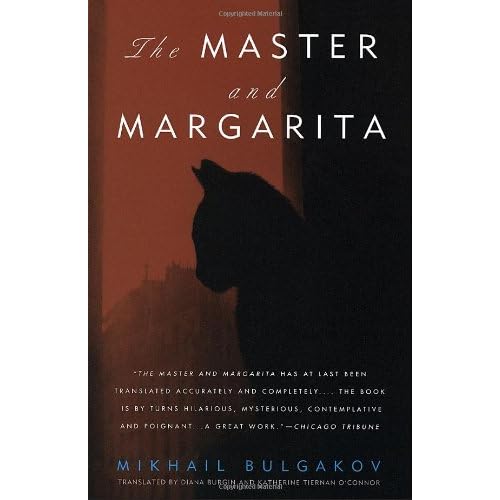
The Master and Margarita


I'll be honest and tell you that this book lost me on about page 3 and I gave it about 50 more pages of total confusion before I gave up the fight.


After attending our discussion (or their discussion) it seems I missed out on a book that was worth the effort.   However, with a character list that includes  a large walking, talking black cat, several slightly odd Soviet writers and Satan.


I gathered there are several plot lines running, including commentary on life in Russia under the Stalin regime and a reworking of the stories of
Pontius Pilate and Faust.


The discussion of the book, especially the Pontius Pilate (or Pilot as I always thought he was named) was nicely timed at our near Easter event.   Pontius Pilate was the judge who authorized the crucifixion of Jesus Christ.  At one point he 'washed his hands' to show he wasn't responsible for the execution of Jesus, but still sent him to his death.  In The Master & Margarita he is living with his conscience in a never ending state of penance. 


Of our readers who (mostly) finished the book, the reviews were that it was worth the effort.  I walked away from our discussion with a renewed interest to give it a second try.  It is now on the night stand atop the other book that I didn't read that they loved... War and Peace.  I'll get right on it.

Friday, February 17, 2012

State of Wonder

We've read Ann Patchett's work before, Bel Canto and The Magician's Assistant, and both books were appreciated.  Bel Canto even garnered the oh so coveted Seattle Girls Book Group Favorite Book of the Year title.  It truly is an honor that all authors aspire to achieve, well perhaps that may be overstating it a bit, but you catch my drift.  This is an author that we as a group have liked and are willing to keep reading her work.  I will tell you this isn't the case with all the authors.  I do recall hearing a statement regarding a different author (who will remain unnamed) "I'll never give her another *bleep* moment of my life... EVER!" um... ouch.

State of Wonder is the story of Dr. Marina Singh, a researcher for a pharmaceutical development company, who is sent to the deepest jungle in Brazil to track down a doctor who has been conducting research regarding a possible infertility product.  She doesn't really know where she's going, and her friend and colleague who was sent before her has died doing what she is now being asked to do.

In tracking down the doctor, discovering the status of the research and the details about her lost friend Dr. Singh has to face many issues, the jungle, an intimidating and ruthless head of research, the reality of life in the jungle with a tribe of people with different customs, no common language and the ethics of what is right vs. how things are 'supposed' to be done.

During our discussion, we talked a lot about the story, the plot, certain pivotal events and we were very sad that not everyone finished the book. There's a LOT that happens in the last third of the book and we couldn't discuss anything without giving it all away.

Our discussion quickly turned to a discussion regarding the concept of eliminating infertility.  The question was, what if we had the medical technology to enable women to have a baby at any age?  What would the implications be and who gets to decide how old is too old to have a baby?   Don't look at this for an answer, it was a general discussion with no concrete answers although we did agree that the doctor that facilitated the Octo-mom nightmare acted irresponsibly.

We also discussed and wondered about the level of research Ms. Patchett conducted as she wrote this book.  Beth said that she watched an interview that said that the author spent ten days on the Amazon doing research, but it wasn't clear what if any research she did on the medical aspects of the book.

There was some need to suspend disbelief regarding the subject matter, as some of it conflicted with biology lessons from junior high regarding the female fertility infrastructure (wow, that seems like the wrong word.)  Some of our readers also felt that the twists and turns were heavily foreshadowed and that they weren't shocked or surprised by any of the events in the book.  However, we mostly felt it was an enjoyable read, certainly not as ethereal as Bel Canto, but likable none the less.

Monday, January 30, 2012

Freedom

To say our reviews were mixed for this book would be an understatement.  There were those of us who couldn't put it down and others who forced ourselves to finish.   The debate wasn't heated, which can happen when views are so very split on a book.  However, some of the things that one member would call out as frustrating someone else would claim to have appreciated.

We all agree that Jonathan Franzen is a much better writer than our last author, but quite a few of us are weary about reading yet another book describing the angst of (comparably) wealthy middle class white people.   The word bourgeois was actually used in describing the story (not by this re-caper, 'bourgeois' and 'repleat'  are not terms that roll of my fingers or tongue in general conversation. )

The story centers around a trio of people who are in a complicated, but predictable love triangle.  He's a rock star, she's a former collegiate athlete and our other hero is the 'safe and normal guy'' that girls marry.  Throw in some corrupt government contracts, a plot to save a specific bird in exchange for mining rights and you know that no one is happy.  Love is a strong word... their lives are intertwined in an uncomfortable way.

We, as a group, are not put off by unlikable characters, and these did fall mostly into that category.  However, there were glimmers of brilliance in how the characters evolved.  We all tended to appreciate the (forgive me) 'curmudgeonization' of one of the characters who makes it his life mission to rid his neighborhood of free ranging cats.  As someone who is completely obsessed with my idiot neighbors who can't manage their garbage bins, I think everyone should embrace their inner hostile neighbor tendencies from time to time.  Granted, stabbing the tires of the slutty neighbors boyfriend's car is a bit much, but we all have to select our own limits.

While this novel was only mildly well received I think it is important to note that while it did not garner any votes for Favorite book of 2011, it also did not receive any of the dreaded "least favorite" votes.

Wednesday, November 30, 2011

So Much For That

For this book about how a family navigates the twisty world of the health care system during a crisis the reviews from our group were mixed.  We all agreed that the author was not the best writer we've ever read and that her  editors should have talked her into losing a story line that was rather stomach churning and didn't really add to the flavor of the character's journey.  However, we talked about the subject matter for almost two hours, skipping over our normal social chatting.

The book touched on themes of the meaning of marriage, parenting, familial duty, friendships during a crisis and self worth.   Who comes around when the going gets really tough?  Lionel Shriver, our author and a woman, suggests it is not always whom you think it will be.   At one point our main character, Shep makes a list of his wife's friends and puts them into groups, distant friends, close friends and "family".  As they spend a year on her  chronic illness the people in those buckets shift.

We discussed how that happens in real life, one of our members shared the heartbreaking story of a beloved uncle with a devastating illness and she tried everything to be of help and was pushed away.  It sounded like the Uncle and his wife were in hunker down mode and decided that they would handle it on their own.  Granted, those we love that are dying don't have an obligation to make us feel better about it but it is understandable that the inability to spend time with this loved one made the process harder for those that love him.  Another member shared an all too true feeling that when someone you know becomes ill you aren't sure what to say and also you aren't sure if you're really welcome or if you're actually intruding on their intimate and personal space.

We agreed, that statements like "let me know if there's anything I can do" puts the burden back on the patient and or their caregiver, and that it is better to fill a need if you see it.  Something a small as dropping by to mow the lawn or leaving food.  Communication with the patient or the caregiver is key, because

Another member who spent a significant time in the hospital system (but wasn't dying - whew!) shared that when visiting someone in the hospital you should go, but be prepared for anything, including leaving without seeing your person and come with stories.  Do not expect the patient to entertain you.   (I really had to scan my memory to make sure that when visiting her I wasn't guilty of making her do all the work, and I think I get a B+ for my hospital visits.  She still had to run through the medical update with me, but then we moved on to other non-hospital stuff which I'm hoping was enjoyable.)

We think that technology can be used to the patient and families benefit, in that by using social media or a blog the burden of providing the current medical update to everyone can be done once and people can check in without intruding.   I know of several situations where the documenting of the experience has been helpful for the families and is a heartbreaking but wonderful account of their story.  It's a bit voyeuristic, in that you're putting your personal thoughts and state of being out for the world at large to read, but not fielding 800 phone calls a week would be nice.

Back to the book, we all felt that Shriver's descriptions of the inner thoughts of her male characters were too flat and overly "mannish".  Meaning that she didn't seem to give men credit for being well rounded beings and that descriptions of why they loved their wives were limited to "possessing her body" and other physical aspects versus the reality of a complex relationship between two people who have found a connection and decided to work to keep it alive.  Her descriptions of sex from the male point of view were off putting.  (And, I am no prude!)

One important theme in the book was money.  Her points seemed to be that the healthcare system fails to consider the true cost of treatment vs. the value and will continue to push option after option for something to  do and discussions about money are shied away from at the least.  We all know that no doctor will put hard cold odds on your chances of survival or give you a solid timeline, but the soft way of discussing the facts can be very detrimental to the family and the patient.   Shep was made to feel like he was being crass when he brought up the subject of the cost of an experimental medicine vs. the likelihood of any positive results.  As ugly as that conversation would be, we (as a group) agreed that is it one we hoped we could have with our care team.

So, while our opinions on the book were varied, the sentiment seemed to be "we didn't hate it, and there was a lot to talk about."   I will put forth that if you are currently experiencing or just recently experienced a loved one with a chronic illness this book is likely not for you.

Thursday, September 22, 2011

Cleopatra is in the house!

A coin with the image of Cleopatra
As the keeper of the blog, I may be getting poor marks this year.  This post will cover the last two books and I have a call out to the ladies to help me find the book I know I'm missing.  My guess it is one that I didn't actually read and that is why I can't remember it.

Our discussion last night was over the book Cleopatra, a Life by Stacy Schiff.   We skipped over the book group part where we all catch up and immediately jumped into the book.  At first we were marveling over the significance of Cleopatra and her story.  For those of us who were uninformed it was an eye opening read to learn how integral she was in the Caesar / Mark Anthony era.  My image of her was similar to Helen of Troy, someone you hear about but don't really know any details. 

We were impressed that at the time of her reign her gender was a non-issue and the fact that she had children by multiple fathers also didn't seem to bother her people.  She taxed the heck out of everyone and yet was liked. 

We agreed with (a missing Melinda) that at times it felt like the Cleopatra story line was secondary to the drama unfolding in the Roman Empire. We attributed that a bit to the availability of historical reference material.  The "doings" in the RE are well documented while the historical artifacts from Alexandria were largely lost and thus many things are speculation.  The author did not take liberties and describe scenes, moods and conversations that she could not be privy too.  Thank you!

In discussing the tone of the book we wondered what an author like Doris Kerns Goodwin could do with the same subject matter.  We agreed that Ms. Goowin's historical offerings tend to "put you in the room" with the action more than Ms. Schiff's book.  However, we do acknowledge that it would be a lot easier to write about Theodore Roosevelt or the Kennedy's because of the availability of their schedules, writings, and the documents that others who were in the room provided.

We felt that the second half of the book flowed better and was far more intriguing.  The first half read like a college history book.  In fact, one of our members had to spend the day with her daughter in the car on an unexpected road trip, so she downloaded the audio book and the daughters response was that mom was reading a history book.  We enjoyed the book, but personally I think it is great torture for the teen to have to endure mom's book.

Our understanding of the era has increased and individuals whom we knew little about have become clearer.  Herod - bad guy.  Mark Anthony - love sick warrior.

Wednesday, September 21, 2011

The Light of the Evening, Edna Obrien

This is the tale of Dilly an Irish woman and her relationships, primarily that of the one between her and her daughter. 

Dilly is dying and in the hospital and is recalling her life - her move to America where she endures a horrific journey to arrive basically alone without  a plan.  A distant cousin sets her up as a domestic servant until that falls apart.  She ends up back in Ireland where she marries and has children.  Suddenly she is old and recalling her daughters story and wishing the daughter would come to visit.   These transitions are not done very well and it isn't clear if it is bad story telling or if Dilly is only giving us information as it comes to her.

At the end of the novel, the story shifts from a narrative to letters and they reveal different nuances of the story.  Mostly this story is about mothers and daughters and communication.  Even when Dilly gets her wish it is unsatisfying.

This is a nice story that doesn't quite work.