Showing posts with label fiction. Show all posts

Wednesday, April 19, 2023

Tomorrow, and Tomorrow, and Tomorrow: A novel


NEW YORK TIMES BEST SELLER • Sam and Sadie—two college friends, often in love, but never lovers—become creative partners in a dazzling and intricately imagined world of video game design, where success brings them fame, joy, tragedy, duplicity, and, ultimately, a kind of immortality. It is a love story, but not one you have read before.


Tomorrow and Tomorrow and Tomorrow follows Sam and Sadie through their childhood meeting, college reunification and the development and success of their business.   

Gabrielle Zevin does a masterful job of maturing the voices of each character over the years and the technical aspects of describing the games they created was detailed and fun to follow.   

As a kid of the 80's the evolution of online games from the Oregon Trail to the role playing games of today is a journey worthy of understanding.  It is a great metaphor for the changes we go through as we become fully formed people.  How the experiences in our lives make for a richer, more colorful experience.

Zevin uses the two characters to narrate from their own perspective, but it isn't repetitive and each has a unique view and of course different priorities and drivers.  

As a story of a lifelong friendship, the cadence also rings true.  Sometimes the friends are in lock step, lives intertwined and at others they are separated but still care deeply for another.  

I appreciated that the characters loved one another, but didn't have to have a grand romantic arc. 

Read:  April 19, 2023
Met: @ Beth's
Book Choice: Melinda

Tuesday, November 26, 2013

2 for 1

Ok, I'm super behind again.

During the annual weekend away, an accounting was done of the books from this year and it turns out I missed the write up for The Snow Child.  So here we go:

The Snow Child, Eowyn Ivey

Fiction is so wonderful when it can make you set aside what you know to be real and allow you to live in a world where anything is possible.  It's Alaska in the 1920's and Jack and Mabel are barely making it.  He works and works and works to keep their Alaska homestead alive and she's doing her part but lonely and heartbroken for the child they didn't have.  They find a moment to play in the snow and form a snow child.

Either through magic or fortune soon they encounter Faina, a lovely girl with blonde hair and a fox for a friend.  Faina saves them, or they save her - either way it's charming and regardless of all the evidence it's never really clear if she's real.

Among our group there was great debate upon the meaning of the ending of this tale, which leads me to believe that the ending was intentionally misleading. Consensus was positive on this particular book.


Weekend away!

Every year we try to plan two extra curricular activities.  The first is the spouse dinner.  This is a challenge to find a night when fourteen people can gather at one time and child care can be obtained for eleven shorties.  We've managed it for the last four years and will keep booking it.

The other event is even harder to arrange.  A weekend where we ladies zip away from our broods and gather in a cozy cottage to dine on chocolate and other yummy foods, hike, do some yoga and of course, talk about the book du jour.   Last year, we were warned away from our hosts cabin in Leavenworth because of late season fires and terrible air quality and this year an early winter storm kept us on the west side of the state.  Lucky for us, our group has some great connections and we fell into comfortable lodgings both times.   This year found us in a charming water front cabin on Vashon Island that snuggly sleeps twelve or very comfortably sleeps seven.


One of the things about the cabin that added to its wonderfulness is that you can't simply drive to the door.  There is a group parking lot and then you have to walk about a third of a mile to the 11th house on the shore.  The walk was quiet and with each step the hustle of life "on land" faded away.

Our book for discussion was "How To Be a Woman".   Part memoir, part stand alone essays on feminism it opened the door for a lengthy discussion on topics that we ladies seldom get into with each other.

I'm sure it would be an easy thing to assume that when gals get together and shut the door they talk about body hair, dating and their weight.  We really don't delve into those areas very often.

Filled with funny moments and a rather long discussion about what to name your vagina (Oh yes, I went there.) this isn't the Susan B. Anthony women's suffrage version of feminism.  It's a straight forward look at our lives today and what it means as we navigate a world where we have to balance people like Kim Kardashian who are famous for goodness knows what, and Nancy Pelosi who is demonized for I'm not sure what maybe being a prickly woman with opinions and being moms, women who have serious jobs.  We're told that we're equal, but the tend to typically fill the board room in the Communications and Human Resources positions.

While the book evoked a long discussion that lasted well into Sunday, we soundly didn't think we liked the author.  The tone of the book was chatty and casual.  Perhaps that's her way of balancing the deep topics she was tackling.

I do give her kudos for not shying away from an unpopular topic.  She and her husband chose to terminate a pregnancy after they had other children.  She writes about this with complete openness and acknowledgement that her decision will be (was) questioned and reviled by many.


Friday, October 4, 2013

Still Alice


As food themes go, I'd like some credit for finding a wine called "Educated Guess" for a story about a Harvard professor with early-onset Alzheimer disease.

With that out of the way, let's talk about this book.

Heartbreaking, amazing, moving, scary and thought provoking.  These are just some of the comments from last nights discussion.

Alice is a respected and beloved Harvard professor who is asked to speak all over the world.  She notices that her reliance on her notes is becoming critical, so she gets it checked out.  The diagnosis, early onset Alzheimer's.

We follow her through the journey of telling her husband, her kids, having to step down at work and the shrinking of her social and physical world.   We are equally frightened of the truth regarding her situation and the terrible impact to Alice and her family.

Because the story is told from her perspective, as things become confusing or 'new' to her our understanding of the narrative shifts.  At first Alice is giving us the nuanced details of a complicated mother & daughter dynamic which eventually devolves into her describing her daughter as that woman with the baby.

Some of us powered through this book in a couple sittings and were moved to tears (me publicly on an airplane) and others were so torn apart by the devastation that they had to read it in small chunks just to not be brokenhearted.

Our appreciation for the research and effort put into this book is great.  We can understand why it is recommended to the caregivers of patients with early-onset Alzheimer's.  

This type of Alzheimer's has a high probability of being genetic, and if you have the gene the likelihood of developing the disease is almost certain.  The author explored the implications of these facts with Alice's three children.  Would you want to know?  It's hard to say.

Our discussion moved to assisted suicide, to estate planning and to the dreaded question of 'who will raise our kids if we're gone.  So many real life issues.

 The book was so well done that it is easy to think of it as non-fiction.  That's a compliment Miss Lisa Genova.  Good work!

Albert of Adelaide

Wanted!


If you want to sound like a crazy person, please describe the book Albert of Adelaide to someone.

Well, it's about this platypus who escapes from a zoo and heads to the Australian outback and along the way is embroiled in an old western shoot out, makes friends with a wombat and has to deal with a gang of kangaroos, thieves and deadly dingoes.  Yes, a gun slinging platypus.

It's been a while since we've read a western, and this one is superb.  The author Howard Anderson has written a fun, and engaging novel.

Our discussions ranged from surprise over the depth of appreciation for the story and the depth of character development to the nuances of social norms and mythical stature that grows when you only know one dimension about an individual.


And The Mountains Echoed

Khaled Hosseini has produced a third book that is equally worth reading.  Author of the Kite Runner and A thousand splendid suns, Hosseini tells us a winding story of intersecting lives that spans continents, generations and families.

Each chapter is told from a different persons point of view and slowly the truth about a father's dreadful choice becomes known and the broad impact unfolds.

We enjoyed this book and I'm sorry to have to admit that it's been 3 or 4 months since our discussion and any remarkable or notable comments from the group have been pushed aside in my memory.

We did note that the style of story telling was remarkably different than his other two novels, and that it took a while for some of us to realize that he was never going to circle back and repeat a narrator.  Freed of that expectation, the story began to crystallize as the characters started overlapping into the chapters and the overall story became clear.

Monday, May 20, 2013

To The Lighthouse


After our gathering to discuss Virginia Woolf’s To The Lighthouse I stand by my previous post, but acknowledge that the discussion it invoked was robust and intriguing.  

Indeed, large portions of the story occur inside the minds of each of the characters.  Melinda pointed out that it was a great study in how different reality is from what we think is happening.  While they had dinner each of the dinner guests had a completely different take on the conversation and interactions.  No one really had a clear take on the others motivations – and in most cases the assumptions being made were 100% removed from the true thoughts of the other persons.

As for my frustration with the pace and flow of the narrative, Christine was adamant that the details that Mrs. Woolf left out simply didn’t matter.   Yes, character A was dead and we don’t need to know why or how, or even what the others thought or experienced when it occurred.  They were dead and it is final.   We didn’t all (me) agree, but I respect her take on the narrative.

It is probably safe to predict that T.T.L. will not earn our Book of the Year prize as less than 50% of us managed to finish it.  That says something when the book is only 175 pages – sure they are serving soup for 100 of those pages, but still.

Mrs. Woolf did have an amazing gift for describing the details of regular life.  In Mrs. Dalloway, which we read in 2000,  a good portion of the story is devoted to preparing for a party, so it should be no surprise that dinner and an eventual journey to the lighthouse would be the plot of an entire book.   In our connected world, we certainly don’t spend this much time analyzing the details of daily life. 

Thursday, May 16, 2013

To The Lighthouse **

**written before our discussion. Ergo all thoughts are my own.

Virginia Woolf to me, is one of those authors whose works are known as capital L - Literature.  She was an important figure and her works are significant.  At least, this is what I think I'm supposed to think.  I find her work challenging to follow, mundane and rather... boring.  I know, as a modern reader I'm tainted by my love of fast media, rapid plots and Sixth Sense type twists.  I'm sure I'm also made lazy by the ability to look up any concept on Google rather than do actual research.  I'm sure I'm also shallow for never needing to spend time speculating the depth and meaning of actions.  I feel a sense of pride for having read Mrs. Dalloway and now To The Lighthouse.  I certainly cannot say I read War and Peace or finished some of the other capital L - Literature selections of late.  I do attribute some of my failures to the lack of forced downtime in the form of a daily bus commute.  However, I will admit that when I am captivated by a book, I find time in my busy life to read.  Oh shoot, I lost my broach.  Mrs. Woolf has a style of story telling that is as brief and stark as it is filled with languid descriptions of everyday tasks.  As I was reading it felt as though Mrs. Ramsay was serving soup to her guests for about 5 pages.  This may not seem overly long, but in a short story of only 117 pages, it was interminable. However later on we are only offered brief but extremely important plot points in the form of editorial notes,and then back to the soup we go.  Furthermore, the narrator will change mid-paragraph and always in the form of internal dialog.  "Gosh, this paragraph seems to be never ending and jumps from idea to idea." Thought the bright, exceedingly beautiful Terri.

[Terri finished the book at 9:00 at Starbucks while drinking a latte.] I had a terrible thought that if Mrs. Woolf spent as much time in her real life going over the details of every conversation and action then it's no wonder she filled her pockets with rocks and went for a swim in an icy river.  GOOD LORD the detail.  Also, and I'll mention this at book group tonight, would it be possible for Mrs. Woolf to loathe women more? She does not write of them kindly, they come across as flighty and useless.  Mrs. Ramsay can't seem to follow a simple discussion about taxation and is completely at at a loss when trying to understand a 20 line poem about the ocean.  Lily, one of the mystery guests at the Ramsay's summer house knows that there is an implicit rule for women to make their across the dinner table partner feel manly and boost his ego, so while he prattles on and on about poetry and heavens knows what, she make a point to smile.  TO SMILE!?  Well done little miss, well done!  For a woman who cannot write or paint, you are very accomplished.  Have some soup.  Wait, don't have a second bowl as Mr. Ramsay becomes angry when others eat when he has finished, I mean how long can this dinner go on?  All the talking and smiling is seriously getting on my nerves. Not that I would ever say anything about it.  You might wait sixteen years before ever hearing "hey, good work - that soup was really good."  Mrs. Ramsay, while not able to follow dinner conversation, very involved in the relationships of others.  Not her own children mind you,  [Sally went up the hill and broke her neck after less than a year.]  Perhaps she should have spent some of her free time at dinner thinking about her match making skills, looking inward at her own situation before deciding to put others together.  Taking driving lessons from the crash test dummies is not a wise choice.  I'm just saying.

Oh, and don't get me started on the Lighthouse.  Are we there yet? Are we going?  When can we go?  We should go.  Oh let's go tomorrow.  Why!?  I DON'T KNOW.  When we get there what will we do?  I DON'T KNOW.  Will it be nice there?  NO.  Will there be food or friends? NO.  Sounds awesome, let's pack up some shitty sandwiches, our painting supplies and some sullen teenagers and get to it!


Thursday, April 11, 2013

Dead Souls, Nikolai Vasilievich Gogol

Ah...Russian literature.

The inside cover of this book touts:  Since its publication in 1842, Dead Souls has been celebrated as a supremely realistic portrait of provincial Russian life and as a splendidly exaggerated tale; as a paean to the Russian spirit and as a remorseless satire of imperial Russian venality, vulgarity, and pomp. As Gogol's wily antihero, Chichikov, combs the back country wheeling and dealing for "dead souls"--deceased serfs who still represent money to anyone sharp enough to trade in them--we are introduced to a Dickensian cast of peasants, landowners, and conniving petty officials, few of whom can resist the seductive illogic of Chichikov's proposition. This lively, idiomatic English version by the award-winning translators Richard Pevear and Larissa Volokhonsky makes accessible the full extent of the novel's lyricism, sulphurous humor, and delight in human oddity and error.

Doesn't that make you want to curl up with a hot cup of tea and get reading?  I mean, who can resist sulphurous humor?  Heck, my spell check doesn't even like it.

So, as with our other tromps into the land of Russian lit, I can say that I've read Tolstoy, Chekov and now Gogol.  I can't say that I've finished many (any) of their greatest works, but I've lived for a moment in their worlds.

There are far better summaries of historical literature than I could ever muster, but the gist of the story is that the hero Chichikov (Chick) has a scheme to make money by purchasing the ownership rights to the slaves of land owners.  However, he only wants the ones that have died.  It's a strange, complicated plan where he saves the landowners from paying taxes on dead people and he ends up looking like a very wealthy man because he owns all these people, that he can mortgage to buy an estate.  Sounds like it should work - not quite.

In making all the transactions we get a commentary on all the different types of people in Russia.  We meet the trusting people, the suspicious people, the vain, stupid people, the drunk nationalists and on an on and on.

We found it entertaining and challenging and even a little repetitive at times.  The book is unfinished and ends mid-sentence.  That can be really frustrating for a reader who needs

Tuesday, January 8, 2013

The Night Circus


Oh what a fun book to read.  It was genuinely enjoyed by all members of our group.  Opening comments that were captured were:

I unabashedly liked it.
It was fluffy and not deep, but took intelligence to follow. 
Incredibly imaginative & vivid.
It's like what a smart goth girl would write when she was all grown up.

Insert picture of author here:

Erin Morgenstern Author Erin Morgenstern attends Summit Entertainment Comic-Con Party at the Hard Rock Hotel on July 21, 2011 in San Diego, California.


We noted that the time shifting between chapters took a while to catch onto.
We liked the Yin & Yang relationship with the various characters, that there were pairs but not couples.

As for the characters, aside from the primary couple, whose love story seemed a little weak and obvious we loved the clockmaker, who was exceptionally well developed and the modern day Bailey.  He seemed like a real person with real world motivations in a fantastical world.

We understand that a movie is already in the works and we discussed if it should bend more towards a Harry Potter feel or Tim Burton.  Either way, we hope Helena Bonham Carter is not cast as the main character.

On the personal side of the discussion we decided that we like short chapters because we can knock them out and it keeps things moving.  Also, I head this quote "I love how our conversations about books mostly evolve to just about us."   True... so true.

Wednesday, May 30, 2012

To the end of the land


To the End of the Land (Vintage International)To over simplify, this book is about mourning someone who is not yet dead, or whose death may be immanent.  In the prologue we meet two young people in an Israeli hospital who have essentially been left on their own due to a conflict raging outside.  Ora and her young friend Avram connect, share secrets and as their time together wears on he brings his silent, and also very ill roommate Ilan into their circle.

Turn the page and it is more than 25 years later.  Ora is devastated to learn that her son has voluntarily reenlisted in order to serve at the West Bank.  Ora's husband, Ilan (what!?) and their son Adam are on a holiday, and rather than stay home and wait for the inevitable knock on the door informing her of her son Ofer's death she drops everything, sort of kidnaps Avram and goes for a walk throughout Galilee.

As the walk, she heals a broken Avram by telling him every detail of Ofers life, his birth, his growth, his stubbornness, and his compassion. As Avram learns more and more about the son he fathered, but never parented (I'm not ruining it, it is not a secret) he is able to shed the pain of his own horrific army experience.

They walk and talk and avoid all news and modern communication in order to delay the inevitable for Ora.

Our readers mostly finished this book (three read to completion, two to almost the end, and one read to a certain point then skipped ahead to the last two chapters) we had one hold out who didn't become engaged.  (There is no judgement from me on that front, sometimes a book doesn't grab you and it is ok to move on!)

My notes from the meeting are as follows:

The narrative was repetitive, with Ora unable to move past her belief that her son was dead but very important details of the characters and their story unfolded when you were not expecting it.

The consensus was that Ora's plight was raw, honest and amazing, but that it was hard to read.

There were several stories that gave insight into what life must be like for people living in this perpetual land of upheaval.   Ora rides the public buses to markets that have been attacked by suicide bombers.  She seems to enjoy stepping on a new bus and having the regular riders assess if she herself is a potential threat, and then as they get to know her she assesses strangers who get on the bus.  Is she facing her fear, or testing fate in order to feel closer to the reality of the conflict?

These episodes point out the fragility of life.  We, in the US for the most part have the luxury of believing we will live into our old age, but the Israeli's don't have that safety.  They are aware that going to the market for milk is a dangerous activity and they have a different relationship with death.  We agreed that a mother would mourn her child to the same level regardless of geopolitical circumstance, but we couldn't decide which would be worse, a constant nagging "it could happen today" feeling or the utter shock of an unexpected death.

So much of this book is centered on Ora and her storytelling, but it is also a lovely tale about fatherhood.


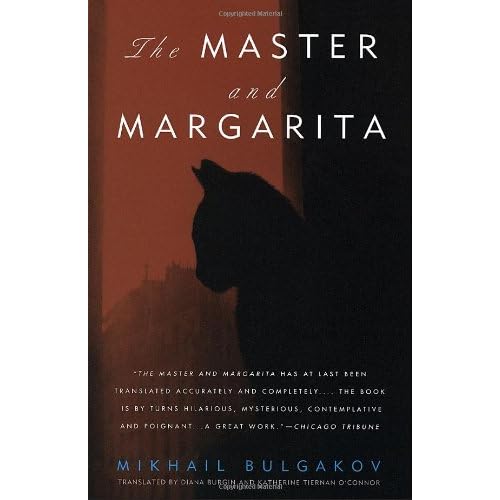
The Master and Margarita


I'll be honest and tell you that this book lost me on about page 3 and I gave it about 50 more pages of total confusion before I gave up the fight.


After attending our discussion (or their discussion) it seems I missed out on a book that was worth the effort.   However, with a character list that includes  a large walking, talking black cat, several slightly odd Soviet writers and Satan.


I gathered there are several plot lines running, including commentary on life in Russia under the Stalin regime and a reworking of the stories of
Pontius Pilate and Faust.


The discussion of the book, especially the Pontius Pilate (or Pilot as I always thought he was named) was nicely timed at our near Easter event.   Pontius Pilate was the judge who authorized the crucifixion of Jesus Christ.  At one point he 'washed his hands' to show he wasn't responsible for the execution of Jesus, but still sent him to his death.  In The Master & Margarita he is living with his conscience in a never ending state of penance. 


Of our readers who (mostly) finished the book, the reviews were that it was worth the effort.  I walked away from our discussion with a renewed interest to give it a second try.  It is now on the night stand atop the other book that I didn't read that they loved... War and Peace.  I'll get right on it.

Friday, February 17, 2012

State of Wonder

We've read Ann Patchett's work before, Bel Canto and The Magician's Assistant, and both books were appreciated.  Bel Canto even garnered the oh so coveted Seattle Girls Book Group Favorite Book of the Year title.  It truly is an honor that all authors aspire to achieve, well perhaps that may be overstating it a bit, but you catch my drift.  This is an author that we as a group have liked and are willing to keep reading her work.  I will tell you this isn't the case with all the authors.  I do recall hearing a statement regarding a different author (who will remain unnamed) "I'll never give her another *bleep* moment of my life... EVER!" um... ouch.

State of Wonder is the story of Dr. Marina Singh, a researcher for a pharmaceutical development company, who is sent to the deepest jungle in Brazil to track down a doctor who has been conducting research regarding a possible infertility product.  She doesn't really know where she's going, and her friend and colleague who was sent before her has died doing what she is now being asked to do.

In tracking down the doctor, discovering the status of the research and the details about her lost friend Dr. Singh has to face many issues, the jungle, an intimidating and ruthless head of research, the reality of life in the jungle with a tribe of people with different customs, no common language and the ethics of what is right vs. how things are 'supposed' to be done.

During our discussion, we talked a lot about the story, the plot, certain pivotal events and we were very sad that not everyone finished the book. There's a LOT that happens in the last third of the book and we couldn't discuss anything without giving it all away.

Our discussion quickly turned to a discussion regarding the concept of eliminating infertility.  The question was, what if we had the medical technology to enable women to have a baby at any age?  What would the implications be and who gets to decide how old is too old to have a baby?   Don't look at this for an answer, it was a general discussion with no concrete answers although we did agree that the doctor that facilitated the Octo-mom nightmare acted irresponsibly.

We also discussed and wondered about the level of research Ms. Patchett conducted as she wrote this book.  Beth said that she watched an interview that said that the author spent ten days on the Amazon doing research, but it wasn't clear what if any research she did on the medical aspects of the book.

There was some need to suspend disbelief regarding the subject matter, as some of it conflicted with biology lessons from junior high regarding the female fertility infrastructure (wow, that seems like the wrong word.)  Some of our readers also felt that the twists and turns were heavily foreshadowed and that they weren't shocked or surprised by any of the events in the book.  However, we mostly felt it was an enjoyable read, certainly not as ethereal as Bel Canto, but likable none the less.

Monday, January 30, 2012

Freedom

To say our reviews were mixed for this book would be an understatement.  There were those of us who couldn't put it down and others who forced ourselves to finish.   The debate wasn't heated, which can happen when views are so very split on a book.  However, some of the things that one member would call out as frustrating someone else would claim to have appreciated.

We all agree that Jonathan Franzen is a much better writer than our last author, but quite a few of us are weary about reading yet another book describing the angst of (comparably) wealthy middle class white people.   The word bourgeois was actually used in describing the story (not by this re-caper, 'bourgeois' and 'repleat'  are not terms that roll of my fingers or tongue in general conversation. )

The story centers around a trio of people who are in a complicated, but predictable love triangle.  He's a rock star, she's a former collegiate athlete and our other hero is the 'safe and normal guy'' that girls marry.  Throw in some corrupt government contracts, a plot to save a specific bird in exchange for mining rights and you know that no one is happy.  Love is a strong word... their lives are intertwined in an uncomfortable way.

We, as a group, are not put off by unlikable characters, and these did fall mostly into that category.  However, there were glimmers of brilliance in how the characters evolved.  We all tended to appreciate the (forgive me) 'curmudgeonization' of one of the characters who makes it his life mission to rid his neighborhood of free ranging cats.  As someone who is completely obsessed with my idiot neighbors who can't manage their garbage bins, I think everyone should embrace their inner hostile neighbor tendencies from time to time.  Granted, stabbing the tires of the slutty neighbors boyfriend's car is a bit much, but we all have to select our own limits.

While this novel was only mildly well received I think it is important to note that while it did not garner any votes for Favorite book of 2011, it also did not receive any of the dreaded "least favorite" votes.

Wednesday, November 30, 2011

So Much For That

For this book about how a family navigates the twisty world of the health care system during a crisis the reviews from our group were mixed.  We all agreed that the author was not the best writer we've ever read and that her  editors should have talked her into losing a story line that was rather stomach churning and didn't really add to the flavor of the character's journey.  However, we talked about the subject matter for almost two hours, skipping over our normal social chatting.

The book touched on themes of the meaning of marriage, parenting, familial duty, friendships during a crisis and self worth.   Who comes around when the going gets really tough?  Lionel Shriver, our author and a woman, suggests it is not always whom you think it will be.   At one point our main character, Shep makes a list of his wife's friends and puts them into groups, distant friends, close friends and "family".  As they spend a year on her  chronic illness the people in those buckets shift.

We discussed how that happens in real life, one of our members shared the heartbreaking story of a beloved uncle with a devastating illness and she tried everything to be of help and was pushed away.  It sounded like the Uncle and his wife were in hunker down mode and decided that they would handle it on their own.  Granted, those we love that are dying don't have an obligation to make us feel better about it but it is understandable that the inability to spend time with this loved one made the process harder for those that love him.  Another member shared an all too true feeling that when someone you know becomes ill you aren't sure what to say and also you aren't sure if you're really welcome or if you're actually intruding on their intimate and personal space.

We agreed, that statements like "let me know if there's anything I can do" puts the burden back on the patient and or their caregiver, and that it is better to fill a need if you see it.  Something a small as dropping by to mow the lawn or leaving food.  Communication with the patient or the caregiver is key, because

Another member who spent a significant time in the hospital system (but wasn't dying - whew!) shared that when visiting someone in the hospital you should go, but be prepared for anything, including leaving without seeing your person and come with stories.  Do not expect the patient to entertain you.   (I really had to scan my memory to make sure that when visiting her I wasn't guilty of making her do all the work, and I think I get a B+ for my hospital visits.  She still had to run through the medical update with me, but then we moved on to other non-hospital stuff which I'm hoping was enjoyable.)

We think that technology can be used to the patient and families benefit, in that by using social media or a blog the burden of providing the current medical update to everyone can be done once and people can check in without intruding.   I know of several situations where the documenting of the experience has been helpful for the families and is a heartbreaking but wonderful account of their story.  It's a bit voyeuristic, in that you're putting your personal thoughts and state of being out for the world at large to read, but not fielding 800 phone calls a week would be nice.

Back to the book, we all felt that Shriver's descriptions of the inner thoughts of her male characters were too flat and overly "mannish".  Meaning that she didn't seem to give men credit for being well rounded beings and that descriptions of why they loved their wives were limited to "possessing her body" and other physical aspects versus the reality of a complex relationship between two people who have found a connection and decided to work to keep it alive.  Her descriptions of sex from the male point of view were off putting.  (And, I am no prude!)

One important theme in the book was money.  Her points seemed to be that the healthcare system fails to consider the true cost of treatment vs. the value and will continue to push option after option for something to  do and discussions about money are shied away from at the least.  We all know that no doctor will put hard cold odds on your chances of survival or give you a solid timeline, but the soft way of discussing the facts can be very detrimental to the family and the patient.   Shep was made to feel like he was being crass when he brought up the subject of the cost of an experimental medicine vs. the likelihood of any positive results.  As ugly as that conversation would be, we (as a group) agreed that is it one we hoped we could have with our care team.

So, while our opinions on the book were varied, the sentiment seemed to be "we didn't hate it, and there was a lot to talk about."   I will put forth that if you are currently experiencing or just recently experienced a loved one with a chronic illness this book is likely not for you.

Wednesday, September 21, 2011

The Light of the Evening, Edna Obrien

This is the tale of Dilly an Irish woman and her relationships, primarily that of the one between her and her daughter. 

Dilly is dying and in the hospital and is recalling her life - her move to America where she endures a horrific journey to arrive basically alone without  a plan.  A distant cousin sets her up as a domestic servant until that falls apart.  She ends up back in Ireland where she marries and has children.  Suddenly she is old and recalling her daughters story and wishing the daughter would come to visit.   These transitions are not done very well and it isn't clear if it is bad story telling or if Dilly is only giving us information as it comes to her.

At the end of the novel, the story shifts from a narrative to letters and they reveal different nuances of the story.  Mostly this story is about mothers and daughters and communication.  Even when Dilly gets her wish it is unsatisfying.

This is a nice story that doesn't quite work. 

Tuesday, September 20, 2011

Collected Stories of Lydia Davis

What can I tell you... I don't respond well to short stories.  I stopped reading after the first few and I wondered if they were all going to be dark and pointless.

I was assured that not all Ms. Davis' stories had that tone and some were actually quite funny. 

This reader didn't finish enough of the book to write a fair review, so instead I will provide a picture of the author.

Friday, May 13, 2011

Slaughterhouse Five


Picking a ‘classic’ can be a crap shoot.  Some books are important in our world collection of works and they stand up to the test of time.  Hemingway's books come to mind for me.  Others are important because of what they meant at the time they were written but they don’t necessarily have the same impact in the modern world. 

As noted in the War & Peace write up, it is an amazing book, but many aspects of the story come across like a gossipy romance novel.  Important – ABSOLUTELY!  Impressive – certainly.   Timeless? – maybe not so much.

Slaughterhouse Five is one of those works.  It is considered an  “American Classic” and was hailed as one of the worlds greatest antiwar books. 

We knew little of the book before reading it.  Personally, I thought the Slaughterhouse Five was a reference to five individuals about whom the story would be centered.  I figured they experienced (or perpetrated) a horrific wartime event.  Nope, the reference is to the name of the building that was their makeshift war camp.    Because of the nature of the building the prisoners who were in that location when the firebombing of Dresden occurred they survived whereas the rest of the prisoners as well as the German captors were killed.   This, however, is NOT the primary story.

Slaughterhouse Five tells the story of Billy Pilgrim, an ill-equipped young man who gets deployed behind the German front at the worst possible time.  Before he can even be issued jack boots he is separated from his unit and ends up being captured.   

Billy survives the war and goes back home to his boring life and his boring wife. 

The story of Billy is not told in a linear style, as Billy experiences ‘shifts’ in time.  He experiences his first moment of getting lost in time in 1944 where he seems to ‘check out’ and jump to a moment in the future.  It is not clear if these time traveling moments are actually his later self-re-experiencing the harsh moments of his life or his way of escaping these moments when they actually occur.  (Perhaps the book The Time Traveler’s Wife ruined me for time travel.)  Regardless, both the flash forwards and the moments in the war are accurate events in Billy's life.

The other unique thing about Billy is that sometimes he time travels to the time that he was abducted by aliens and held in a zoo on their planet.  There he learns that all life events occur simultaneously and all events are destined to happen.  He is informed that he will die on February 13th, 1976 and thus during the war he isn’t filled with terror that his life might end.  This doesn’t give him any extra confidence, but with the knowledge of future events he is more calm than a lesser informed person might be. 

It doesn’t take a genius to notice that the date of Billy’s death is 31 years to the day of the bombing of Dresden.  The 31 years doesn’t seem to see significant, but the author Is saying something about Billy by selecting that date.

We as a group felt that the book was dated and that there are far more detailed and informative books about WW2 available for readers.  The writing style was very simple and many of us finished this novel in a couple days. 

The author uses a phrase “so it goes” to punctuate moments of death.  It was an irritating nuance and while the intention is to show that that’s just how life works, it seemed to hammer the point home long after its usefulness.

A few members stated that this felt like a “boy book”.  We know that’s a dangerous statement because there is no actual definition of girl books or boy books.  The most general explanation I can give is that “boy books” tend to be story driven and little to no effort is made to get beneath the exterior actions of the characters.  Their feelings, fears, joys and emotions are not important to the story.  “Girl books” tend to present more of a balance between the plot points and how the characters feel about what is happening.  Cliché?  Sure, but this is our opinion.  For the record, war books can be “girl books” – The Things They Carried and Regeneration both fall into the “girl book” category for us.  Both were great reads and by no means should the males in our world ignore them as trivial.

We discussed the time travel aspect of the book at great length and wondered if when the novel was written if Vonnegut had much experience with men who had what we now call Post Traumatic Stress Disorder.  We felt that Billy’s time travel was a symptom of PTSD.

Vonnegut tells this story with great detail because he in fact was a prisoner held in the underground slaughterhouse and while he is NOT the Billy Pilgrim character he does write his experiences into the novel. 

The randomness of who will live and who will die in a war situation are highlighted in that Billy Pilgram had no skills, no supplies and really no friends and yet he comes home, while another character is strong, savvy, well connected and ends up being shot to death over the theft of a teapot.  A teapot is a great metaphor for the most useless and trivial thing to die for in a city that has just been destroyed and all inhabitants have just died.  A teapot!

I for one am glad that to have finally read this novel.  Not because it was so great and mind-blowingly entertaining, but because it is part of our American Classics collection and it isn’t fair to comment on current authors without the benefit of having the critically acclaimed authors and books under your belt too.

Thursday, May 12, 2011

War and Peace

Fair warning, I did not actually read this book.  I purchased it and made it to page 81 (well, my bookmark landed between page 80 and 81) but my notes will be heavily relied upon for the about to be very brief recap.

When we selected this book we did not specify a specific publication and we thought it wouldn't matter.  We thought there would be time to discuss the nuances between the different versions.  We are foolish.  We failed to remember that there are entire college courses devoted to the study of this work of fiction, and we thought that in addition to discussing the tone, story, character development, imagery, plot, historical accuracy, the essays, and intended messages that we could also compare various versions.  FOOLS.

We could have spent the entire 2 hours discussing the different plot points - who died in one book didn't in another, and which version of the story was "better".  As an observer it did seem that the gals who read the unabridged version seemed quite pleased with the longer more elaborate story line. 

Regardless of version read, there was a common feeling that the sections where Tolstoy is discussing his views of war were beating you over the head.  "Here's my point.  Here it is again, and just in case you missed it, this is my point."  No one seemed to dislike or take issue with the fact that in addition to the linear story of the five families that there were what read like essays interspersed.

One point that Tolstoy seemed to drive home is that there is a clear juxtaposition between the ideal of how glorious war is (was) often depicted and the reality of what it is really like.   He also makes it clear that it is his opinion that the idea that the war lends an implicit authorization to kill a large number of people, but in the end, it is still just murder.  Murder on a larger scale.

Tolstoy himself experienced war and did extensive research on the French invasion of Russia in 1812.  He used is own history and his learned knowledge to craft what is one of the best known books of all time. Most every point of fact regarding the events in his book have been annotated, in fact, there are points where he didn't have a reference and he calls those out as well.  This here* is fact and this** is something I couldn't find reference on.  That attention to detail is rarely seen.

The book was well received by the book group even though "it took 300 pages to figure out who was who", but after the characters were established the book "flew by".   This was one of our few book groups were the discussion of the book started the moment there was a majority of attendees and didn't stop until people were dropping like flies.  Heck, I brought a 4 week old baby to the meeting and she was of minor interest. 

The excited discussion was very fun to listen to and made me want to finally take the time to read it.  However, I went home fell asleep and my copy is now buried under other books that are getting my limited attention.  Maybe someday.  Maybe.

Thursday, January 20, 2011

A little late, but here's Little Bee


In November the ladies packed their cars and snow gear for a weekend getaway.  We ventured over Stevens Pass to Plain, Wa (outside Leavenworth) for a cozy couple days. 

As usual, the food was amazing and the wine flowed freely.  There was a couple AM yoga sessions and walks in the snow.  Over breakfast Saturday morning we discussed our book, Little Bee by Chris Cleeve.

It is the story of a young immigrant girl, Little Bee,  from Nigeria who comes to England to find a husband and wife whom she encountered on a beach in her native land.

The story is told from the perspective of Little Bee and Sarah, the British wife. Their story is unique but at times not really very believable, however the story moved along quite well and we as a group had many topics to discuss. 

We weren't too impressed with some of the decisions that Sarah makes and thought that she was needlessly endangering her own life and the life of her 5 year old son.   Her reaction to certain events seemed untruthful and distant.  She makes a grand gesture for a stranger and then is cold and distant when an intimate is in need.

The book jacket practically implores you to not reveal the plot to others implying a rather large "gotcha" or "wow" moment. There is some devastating violence and the death of significant characters, but perhaps we are jaded as readers we didn't have a "Crying Game" / "Sixth Sense" moment that was somewhat implied. 

We think the author was attempting to comment on the shadow people who are illegal immigrants as well as the corrupt political structure in Nigeria, but both were used as plot points and thus softened somewhat. 

For the most part, we liked the book, bleak as it was, but I think we enjoyed our weekend together more.

Thursday, October 21, 2010

Cutting For Stone, Abraham Verghese

Well, what a beautiful and satisfying book.  The author weaves a tale of twin brothers who are raised in a hospital in Ethiopia during an era of revolution.  They are aware of the unconventional family in which they find themselves in and excel in their own ways.

They are at the core of a tragedy, a mystery, lost and missing family.  They are well cared for and loved.  Their story unfolds mostly through the narration of one of the twins.  Marion, like all the characters in this book, is well rounded, complicated and human.  His maturity expands as the story unfolds and his transformation from child to man is stunning.

Our book discussion jumped from topic to topic mostly on the bent of "I LOVED THIS PART" and "I loved how this was written."   We found that in spite of the books 650 pages that it was a quick read.  To say we devoured it would be an understatement.

Dr. Verghese, if you ever Google your own name and find our silly little blog we want to invite you to come to dinner.  WE LOVED YOUR BOOK!

We were infinitely impressed with the amount of medical information in the story, especially around surgeries and illnesses and how it was extremely accessible to us non-doctor type people.  The journey of our characters to become a doctor and the involvement of the multiple doctors and medical personnel could have been tedious, but it wasn't, it was lovely.

The only loud and remotely negative comment related to this story is the general outrage that smart men have trouble walking away from women who are 'trouble'.  This isn't a complaint about the book as much as a commentary on humans (women do it too.)  What is it about us that we see others for who we want them to be, rather than who they may have become?    Is it so hard to accept that if someone hits you, lies to you, manipulates you, sleeps with your best friend, kills your cat, sets your house on fire, takes your savings or other general malfeasance that maybe, just maybe they aren't worthy of your love???  Sorry for the side track - I'm not suggesting that forgiveness isn't an option, but snap out of it, some people are douche bags.  Learn to recognize them and get them out of your life!

Back to the point.  Cutting for Stone, confusing title and all, was well received by our humble group, come dine and discuss with us Dr. Verghese.  We want to shower you with our appreciation.