Wednesday, June 20, 2012

In the Garden of Beasts


There comes a time in every readers life when they ask "How many Holocaust books can I stand to read?"  This particular non-fiction book delves into the events during Adolf Hitler's rise to power as witnessed by the American Ambassador William E. Dodd, who arrived in Berlin in 1933 with his family.  If you're only going to read one book in your lifetime about this dark, but significant historical period, In the Garden of Beasts is not the book to read.   The author, Larson, makes the assumption that the reader knows what happened once the war started and how events unfolded.  There are references to the camps, but since the book is about Dodd and his experiences those horrific details aren't delved into.

This focus on the experiences of Dodd and his colorful family (mostly his daughter Martha) is an interesting view.  Larson doesn't take a stand as to weather or not Dodd is a hero or a bumbling fool who could have been more adamant about what he was seeing in Berlin.  It is clear that it was a complicated world and that the messages from the Hitler camp was that they wanted peace.  Sure, there was the slight Jewish Problem but mostly that issue was handled away from the everyday life of "regular" people.   The slow and steady crimp of the freedoms and liberty were so (forgive the phrase) well done that no one felt the need (or ability) to protest.  Those that did, as we know, were promptly dealt with.

As a group, we felt it was an accessible book but hard to read at times.  Hard, not because of the subject matter but because the events were happening and it is so obvious to us with the luxury of knowledge that something needed to be done.  Dodd was in the position to influence the American participation but his focus on diplomacy was maddening.

Larson suggests that Dodd was sent to keep relations with the Germans in good standing because they owed the US money and if the relationship broke down then the likelihood of being repaid dwindled.  It all comes down to money.

Dodd and his adult daughter Martha are the most well drawn characters in this book.  His wife and son are present, but as they didn't keep their own diaries their perspective and participation seem to be to the side.  Martha was busy while in Germany.  She "dated" a number of men, had affairs and was excited to dine with Hitler.   After the truth about what was happening and about to happen in Germany came out I doubt Martha was so thrilled with her encounter.

Perhaps it is because Erik Larson is a local author, but most of us encountered strangers who felt the need to comment on this book when we were seen reading it.  It was good, but not the end all be all WWII political account.


Wednesday, May 30, 2012

To the end of the land


To the End of the Land (Vintage International)To over simplify, this book is about mourning someone who is not yet dead, or whose death may be immanent.  In the prologue we meet two young people in an Israeli hospital who have essentially been left on their own due to a conflict raging outside.  Ora and her young friend Avram connect, share secrets and as their time together wears on he brings his silent, and also very ill roommate Ilan into their circle.
Turn the page and it is more than 25 years later.  Ora is devastated to learn that her son has voluntarily reenlisted in order to serve at the West Bank.  Ora's husband, Ilan (what!?) and their son Adam are on a holiday, and rather than stay home and wait for the inevitable knock on the door informing her of her son Ofer's death she drops everything, sort of kidnaps Avram and goes for a walk throughout Galilee.

As the walk, she heals a broken Avram by telling him every detail of Ofers life, his birth, his growth, his stubbornness, and his compassion. As Avram learns more and more about the son he fathered, but never parented (I'm not ruining it, it is not a secret) he is able to shed the pain of his own horrific army experience.

They walk and talk and avoid all news and modern communication in order to delay the inevitable for Ora.

Our readers mostly finished this book (three read to completion, two to almost the end, and one read to a certain point then skipped ahead to the last two chapters) we had one hold out who didn't become engaged.  (There is no judgement from me on that front, sometimes a book doesn't grab you and it is ok to move on!)

My notes from the meeting are as follows:

The narrative was repetitive, with Ora unable to move past her belief that her son was dead but very important details of the characters and their story unfolded when you were not expecting it.

The consensus was that Ora's plight was raw, honest and amazing, but that it was hard to read.

There were several stories that gave insight into what life must be like for people living in this perpetual land of upheaval.   Ora rides the public buses to markets that have been attacked by suicide bombers.  She seems to enjoy stepping on a new bus and having the regular riders assess if she herself is a potential threat, and then as they get to know her she assesses strangers who get on the bus.  Is she facing her fear, or testing fate in order to feel closer to the reality of the conflict?

These episodes point out the fragility of life.  We, in the US for the most part have the luxury of believing we will live into our old age, but the Israeli's don't have that safety.  They are aware that going to the market for milk is a dangerous activity and they have a different relationship with death.  We agreed that a mother would mourn her child to the same level regardless of geopolitical circumstance, but we couldn't decide which would be worse, a constant nagging "it could happen today" feeling or the utter shock of an unexpected death.

So much of this book is centered on Ora and her storytelling, but it is also a lovely tale about fatherhood.


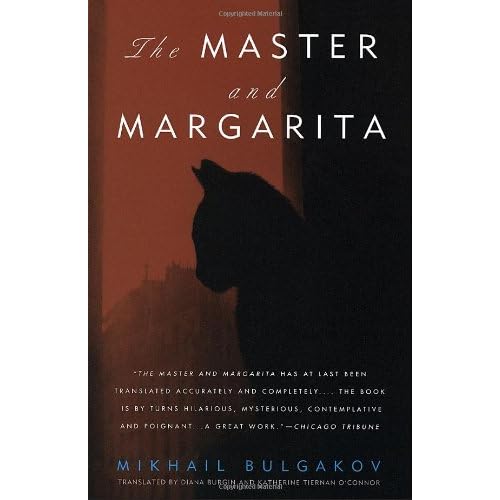
The Master and Margarita


I'll be honest and tell you that this book lost me on about page 3 and I gave it about 50 more pages of total confusion before I gave up the fight.


After attending our discussion (or their discussion) it seems I missed out on a book that was worth the effort.   However, with a character list that includes  a large walking, talking black cat, several slightly odd Soviet writers and Satan.


I gathered there are several plot lines running, including commentary on life in Russia under the Stalin regime and a reworking of the stories of
Pontius Pilate and Faust.


The discussion of the book, especially the Pontius Pilate (or Pilot as I always thought he was named) was nicely timed at our near Easter event.   Pontius Pilate was the judge who authorized the crucifixion of Jesus Christ.  At one point he 'washed his hands' to show he wasn't responsible for the execution of Jesus, but still sent him to his death.  In The Master & Margarita he is living with his conscience in a never ending state of penance. 


Of our readers who (mostly) finished the book, the reviews were that it was worth the effort.  I walked away from our discussion with a renewed interest to give it a second try.  It is now on the night stand atop the other book that I didn't read that they loved... War and Peace.  I'll get right on it.

Friday, February 17, 2012

State of Wonder

We've read Ann Patchett's work before, Bel Canto and The Magician's Assistant, and both books were appreciated.  Bel Canto even garnered the oh so coveted Seattle Girls Book Group Favorite Book of the Year title.  It truly is an honor that all authors aspire to achieve, well perhaps that may be overstating it a bit, but you catch my drift.  This is an author that we as a group have liked and are willing to keep reading her work.  I will tell you this isn't the case with all the authors.  I do recall hearing a statement regarding a different author (who will remain unnamed) "I'll never give her another *bleep* moment of my life... EVER!" um... ouch.

State of Wonder is the story of Dr. Marina Singh, a researcher for a pharmaceutical development company, who is sent to the deepest jungle in Brazil to track down a doctor who has been conducting research regarding a possible infertility product.  She doesn't really know where she's going, and her friend and colleague who was sent before her has died doing what she is now being asked to do.

In tracking down the doctor, discovering the status of the research and the details about her lost friend Dr. Singh has to face many issues, the jungle, an intimidating and ruthless head of research, the reality of life in the jungle with a tribe of people with different customs, no common language and the ethics of what is right vs. how things are 'supposed' to be done.

During our discussion, we talked a lot about the story, the plot, certain pivotal events and we were very sad that not everyone finished the book. There's a LOT that happens in the last third of the book and we couldn't discuss anything without giving it all away.

Our discussion quickly turned to a discussion regarding the concept of eliminating infertility.  The question was, what if we had the medical technology to enable women to have a baby at any age?  What would the implications be and who gets to decide how old is too old to have a baby?   Don't look at this for an answer, it was a general discussion with no concrete answers although we did agree that the doctor that facilitated the Octo-mom nightmare acted irresponsibly.

We also discussed and wondered about the level of research Ms. Patchett conducted as she wrote this book.  Beth said that she watched an interview that said that the author spent ten days on the Amazon doing research, but it wasn't clear what if any research she did on the medical aspects of the book.

There was some need to suspend disbelief regarding the subject matter, as some of it conflicted with biology lessons from junior high regarding the female fertility infrastructure (wow, that seems like the wrong word.)  Some of our readers also felt that the twists and turns were heavily foreshadowed and that they weren't shocked or surprised by any of the events in the book.  However, we mostly felt it was an enjoyable read, certainly not as ethereal as Bel Canto, but likable none the less.

Monday, January 30, 2012

2011 Book of the Year

(Oh my goodness, aren't my graphics AMAZING?)

Our Book list for 2011
Freedom
So Much for That
Unbroken: A World War II Story of Survival, Resilience, and Redemption
Cleopatra, a life
The Light of Evening
Collected Stories of Lydia Davis
Slaughterhouse Five
The Immortal Life of Henrietta Lacks
War and Peace

This year instead of debating openly about our favorites and potentially tainting each other's opinions with our own adamant love for our standouts, we conducted a paper vote.  It was surprisingly fast and efficient, but I would say that I personally missed the debate about the merits of the books, especially the one's we read earlier in the year.  Perhaps next year we'll talk about the books then do the paper vote.  It is very interesting to see what sticks with people.  

The votes were reasonably split between The Immortal Life of Henrietta Lacks and Unbroken, but it was really no contest.  Unbroken: A World War II Story of Survival, Resilience, and Redemption by Laura Hildebrand hands down earns our 2011 book of the year title.  (You'll not find a write up for Unbroken (yet) as I had a work event that pulled me away from the meeting and I unfortunately didn't start reading it until this last weekend.  I will say, once I started I regretted my delay. It is quite engaging.)

Our members were also taken with War & Peace and of course Henrietta Lacks, Cleopatra got a nod for being an excellent, and interesting read, but the votes were for Unbroken.

As for what we use to call our "worst book of the year" this title has been renamed "least favorite".  We were called on the carpet by the author of our 'least favorite' last year and we stand by our rights to rank our reading list and yet we intend no disrespect to the talented authors who have published works.   This "least favorite" title is nothing but that, it is the book that we least liked out of our list.  It doesn't mean the book wasn't impactful or important, but we simply didn't like it better than anything else on our list this year.

So, after all that, which of the above titles failed to touch us?  The Collected Stories of Lydia Davis.   Sorry Ms. Davis, we've done short stories and liked them, but these did not work their way into our hearts.  

We're looking forward to 2012 and sharing our finds with you.  Thank you for checking in.   Next up, the recap and (maybe) recipes from our annual spousal dinner.

Freedom

To say our reviews were mixed for this book would be an understatement.  There were those of us who couldn't put it down and others who forced ourselves to finish.   The debate wasn't heated, which can happen when views are so very split on a book.  However, some of the things that one member would call out as frustrating someone else would claim to have appreciated.

We all agree that Jonathan Franzen is a much better writer than our last author, but quite a few of us are weary about reading yet another book describing the angst of (comparably) wealthy middle class white people.   The word bourgeois was actually used in describing the story (not by this re-caper, 'bourgeois' and 'repleat'  are not terms that roll of my fingers or tongue in general conversation. )

The story centers around a trio of people who are in a complicated, but predictable love triangle.  He's a rock star, she's a former collegiate athlete and our other hero is the 'safe and normal guy'' that girls marry.  Throw in some corrupt government contracts, a plot to save a specific bird in exchange for mining rights and you know that no one is happy.  Love is a strong word... their lives are intertwined in an uncomfortable way.

We, as a group, are not put off by unlikable characters, and these did fall mostly into that category.  However, there were glimmers of brilliance in how the characters evolved.  We all tended to appreciate the (forgive me) 'curmudgeonization' of one of the characters who makes it his life mission to rid his neighborhood of free ranging cats.  As someone who is completely obsessed with my idiot neighbors who can't manage their garbage bins, I think everyone should embrace their inner hostile neighbor tendencies from time to time.  Granted, stabbing the tires of the slutty neighbors boyfriend's car is a bit much, but we all have to select our own limits.

While this novel was only mildly well received I think it is important to note that while it did not garner any votes for Favorite book of 2011, it also did not receive any of the dreaded "least favorite" votes.

Wednesday, November 30, 2011

So Much For That

For this book about how a family navigates the twisty world of the health care system during a crisis the reviews from our group were mixed.  We all agreed that the author was not the best writer we've ever read and that her  editors should have talked her into losing a story line that was rather stomach churning and didn't really add to the flavor of the character's journey.  However, we talked about the subject matter for almost two hours, skipping over our normal social chatting.

The book touched on themes of the meaning of marriage, parenting, familial duty, friendships during a crisis and self worth.   Who comes around when the going gets really tough?  Lionel Shriver, our author and a woman, suggests it is not always whom you think it will be.   At one point our main character, Shep makes a list of his wife's friends and puts them into groups, distant friends, close friends and "family".  As they spend a year on her  chronic illness the people in those buckets shift.

We discussed how that happens in real life, one of our members shared the heartbreaking story of a beloved uncle with a devastating illness and she tried everything to be of help and was pushed away.  It sounded like the Uncle and his wife were in hunker down mode and decided that they would handle it on their own.  Granted, those we love that are dying don't have an obligation to make us feel better about it but it is understandable that the inability to spend time with this loved one made the process harder for those that love him.  Another member shared an all too true feeling that when someone you know becomes ill you aren't sure what to say and also you aren't sure if you're really welcome or if you're actually intruding on their intimate and personal space.

We agreed, that statements like "let me know if there's anything I can do" puts the burden back on the patient and or their caregiver, and that it is better to fill a need if you see it.  Something a small as dropping by to mow the lawn or leaving food.  Communication with the patient or the caregiver is key, because

Another member who spent a significant time in the hospital system (but wasn't dying - whew!) shared that when visiting someone in the hospital you should go, but be prepared for anything, including leaving without seeing your person and come with stories.  Do not expect the patient to entertain you.   (I really had to scan my memory to make sure that when visiting her I wasn't guilty of making her do all the work, and I think I get a B+ for my hospital visits.  She still had to run through the medical update with me, but then we moved on to other non-hospital stuff which I'm hoping was enjoyable.)

We think that technology can be used to the patient and families benefit, in that by using social media or a blog the burden of providing the current medical update to everyone can be done once and people can check in without intruding.   I know of several situations where the documenting of the experience has been helpful for the families and is a heartbreaking but wonderful account of their story.  It's a bit voyeuristic, in that you're putting your personal thoughts and state of being out for the world at large to read, but not fielding 800 phone calls a week would be nice.

Back to the book, we all felt that Shriver's descriptions of the inner thoughts of her male characters were too flat and overly "mannish".  Meaning that she didn't seem to give men credit for being well rounded beings and that descriptions of why they loved their wives were limited to "possessing her body" and other physical aspects versus the reality of a complex relationship between two people who have found a connection and decided to work to keep it alive.  Her descriptions of sex from the male point of view were off putting.  (And, I am no prude!)

One important theme in the book was money.  Her points seemed to be that the healthcare system fails to consider the true cost of treatment vs. the value and will continue to push option after option for something to  do and discussions about money are shied away from at the least.  We all know that no doctor will put hard cold odds on your chances of survival or give you a solid timeline, but the soft way of discussing the facts can be very detrimental to the family and the patient.   Shep was made to feel like he was being crass when he brought up the subject of the cost of an experimental medicine vs. the likelihood of any positive results.  As ugly as that conversation would be, we (as a group) agreed that is it one we hoped we could have with our care team.

So, while our opinions on the book were varied, the sentiment seemed to be "we didn't hate it, and there was a lot to talk about."   I will put forth that if you are currently experiencing or just recently experienced a loved one with a chronic illness this book is likely not for you.